
Zone d'Erotica
Theories on the erotic and the public, featuring my close personal friend Connor Storrie


This essay owes a debt to my friends Joe and Ashley who threw the wedding of the millennium last month—and included a brief on Houston’s zoning laws in their guide to the city for out-of-town guests. And if you want to read more on the rich text that is Zone d’Erotica, check out Hannah Smothers’ Something Nice.
For a kid with no car, there isn’t a better place to grow up than Houston, Texas. I didn’t get my driver’s license until I was 19 years old, so I spent countless hours of my childhood walking around the very-much-not-pedestrian-friendly city. But without any zoning laws, I was rarely too far from a coffee shop or a shopping center where I could find a summer job—where I could be paid that sweet, sweet $7.25/hour minimum wage to clean up after women who left the dressing rooms a mess.
Houston is the largest city in the United States that does not have zoning laws: land use regulations that traditionally separate residential, commercial, and industrial buildings. Growing up, I didn’t know any different than the fabric of my city, its patchwork pattern. Crematoriums border cul-de-sacs border skyscrapers.
So the joke between my mom and me when we drove past the Zone d’Erotica adult entertainment and lingerie store was not that the red and purple facade looked out of place on the city’s main east–west thoroughfare, where Westheimer Road crossed under the 610 highway loop at the Galleria—one of the biggest shopping malls in the country and a veritable tourist hotspot. No, the joke was the sex. I could say the word “erotica” in front of my mom, and we would both laugh.
For my 25th birthday this year, I happened to be back in Houston for a friend’s wedding. My mom came in to celebrate with me from Tyler in East Texas, where she grew up and where she now lives with my stepdad. My dad doesn’t live in Houston anymore either, so I don’t have a regular excuse to visit the city where I grew up.
When I landed at Hobby Airport, I couldn’t keep my face from cracking open with a grin. It seemed the air was sweeter; the colors, crisper. I wondered if this was how my mom felt moving back to her hometown. My hair had already started to frizz up from the humidity, and I didn’t care. I walked out to the passenger pickup area to call a Lyft; for the first time in my life, there was no one to pick me up.
I was staying at our family friends’ house, while they were all out of town. Their two daughters are close to my age, the sisters I never had, and their parents are my mom’s best friends (and my “bonus parents”). I knew everything about that house, where the staircases creaked, what the kitchen had looked like before all the renovations—but standing there with my luggage, I realized I didn’t know the address. Somehow I had never added it to their contacts. I’d never needed to. It was a few blocks south of the Rice Village shopping center, a left onto Swift Boulevard from the street (was it Greenbriar?) on which their elementary school sat. Our other best friend’s childhood home was a few blocks further down, right before Swift dead-ended into the western edge of the Houston Medical Center (zoning laws, remember?). It felt too silly to ask for this detail now, after more than 20 years of friendship. I dropped a pin somewhere on Swift and navigated the Lyft driver from memory once we were close. I punched in the gate code and retrieved the spare key.
There was no one inside, not even their geriatric bichon frise, who was spending the weekend with a dogsitter. It felt like the rapture had happened, and I had been left behind. My feet touched the cold tile that we’d splashed water onto for years, ever since they put a pool in their backyard. The refrigerator in the mud room was stocked as always with a glittering array of seltzers and flavored sparkling water. When I was young, I envied their endless supply of Izzes, a fizzy fruit juice that seemed then the height of luxury.
I walked around the house, running my fingers over the familiar surfaces like a blind person who had finally been granted sight. Frames with old family portraits, heights marked in pencil on door frames. This was the closest thing I had to a childhood home, I realized, except none of the artifacts were my own, and no one was there to reminisce with me.1
I had met the girls at church as a child. We grew up together in a Southern evangelical Presbyterian church, where all of our families were figures in the social firmament. My parents taught bible study. My friends’ dads were elders or deacons. (Our moms couldn’t serve in these positions of leadership, of course, because they were women.) In my dad’s used Cadillac, we’d crest I-610 every Sunday on the way to church—sometimes twice in one day, returning for youth group in the evening after the morning service. There was no mention of Zone d’Erotica in dad’s car. The joke would not have landed.
My mom and I talked about everything, but we did not talk about sex. Even at youth group, where our parents ostensibly sent us to keep us from straying, like wayward sheep, from the Lord’s flock, there was no sex education. Abstinence was a foregone conclusion. Our youth pastors were comfortable in the realm of euphemism and catechism. But if they assumed our parents were teaching us about safety and sexuality, our parents assumed the very opposite.
The closest thing I remember to being taught about sexuality at church was an honest-to-god spoken word performance by our youth pastor of the lyrics to the top-40 song “Honey I’m Good” by Andy Grammar. The sky was dark outside. Across the parking lot, you could see the floodlights of the Walmart Super Center across the street. The other high school–aged kids with whom we’d grown up were seated in rows of folding chairs after having gorged ourselves on pizza. At the front of the room, my third favorite of the youth pastors was standing with a sheet of sweaty printer paper in his hand, from which he read aloud in a serious tone:
Now, better men than me have failed
Drinkin’ from that unholy grail
Now check it out
I got her and she got me and you got that ass
But I kindly gotta be likeOh, baby, nah, baby, you got me all wrong, baby
My baby’s already got all of my loveSo nah, nah, honey, I’m good
I could have another but I probably should not
I got somebody at home and if I stay I might not leave alone
On its surface, it seemed an innocent enough pop hit. A torch song for abstinence. The singer turns away from temptation and remains faithful. Right?
Oh, ye of little faith. This song, it turns out, was the devil’s work, our pastor entreated us. No matter that other Billboard hits from 2014 included “Talk Dirty” by Jason Derulo and Pitbull’s “Timber.” Andy Grammar’s lyrics were insidious, and therefore even more of a threat. The singer may not have disobeyed the seventh commandment and committed adultery, but the 10th commandment forbids coveting a neighbor’s wife. “That ass”? Covetable.
I’m sure some of the teenage boys in the audience were trying desperately not to laugh. But I felt stricken, and a little shortchanged. If he thought this song was bad, he should hear some of the other stuff on the radio, or what came out of those boys’ mouths. Did he know that the Internet existed? At that point, many of us still didn’t have smartphones or weren’t allowed to have social media accounts, but there were always ways around this. It just took one lucky friend with a laptop and a lax parent for information to spread like a sexually transmitted disease.
By virtue of being in a big city, and being involved in community theatre from an early age, I was always on the knife’s edge of something ungirded. Within walking distance from their house, my friends and I used to wander around Rice Village without needing parental supervision. At the Urban Outfitters, I bought my first black lace bralette, a halter neck that I wore proudly peeking out from under my T-shirts and dresses. I learned what a marijuana plant looked like from a string of leaf-shaped fairy lights in the home decor section. It would take me years still to realize that Lorde’s “Pure Heroine,” blaring from the store’s speakers, was a double entendre with the name of an illicit drug.
By the time I did get an iPhone and an Instagram account, I was a freshman at the High School for the Performing and Visual Arts, a public magnet for which I’d had to undergo several rounds of auditions. The culture shock from my tiny private Baptist middle school—where I’d gone to chapel every Wednesday and taken Bible classes every year and not been able to find the Harry Potter books on the shelves of the school library—was violent and delightful.
I read somewhere, likely Substack, about an interesting theory of the public in our smartphone age. Rather than an incursion upon public space, the writer argued, phones instead constitute an erosion of the private space. When someone on the subway is scrolling through TikTok or playing Candy Crush at full volume, I am made a part of their private world, whether I want to be or not. I have been an unwilling, one-sided voyeur into so many phone calls—crises, the formation and dissolution of relationships, arguments, inside jokes—just by walking to the grocery store. Whenever someone is taking a Zoom meeting in a coffee shop without headphones, I have the childish urge to tell the teacher on them. Sometimes I think I missed my calling as a librarian. I get off on telling people to hush.
And that’s another thing. Who knows what people could be listening to on their headphones these days, even when they deign to wear them. One of the biggest television series in the world this year was Heated Rivalry, which became the most-watched acquired scripted series in HBO history with 10.6 million views in its first month of streaming. Both of its stars went from waiting tables to serving as official torchbearers for the 2026 Olympics and appearing on Saturday Night Live within a single calendar year.
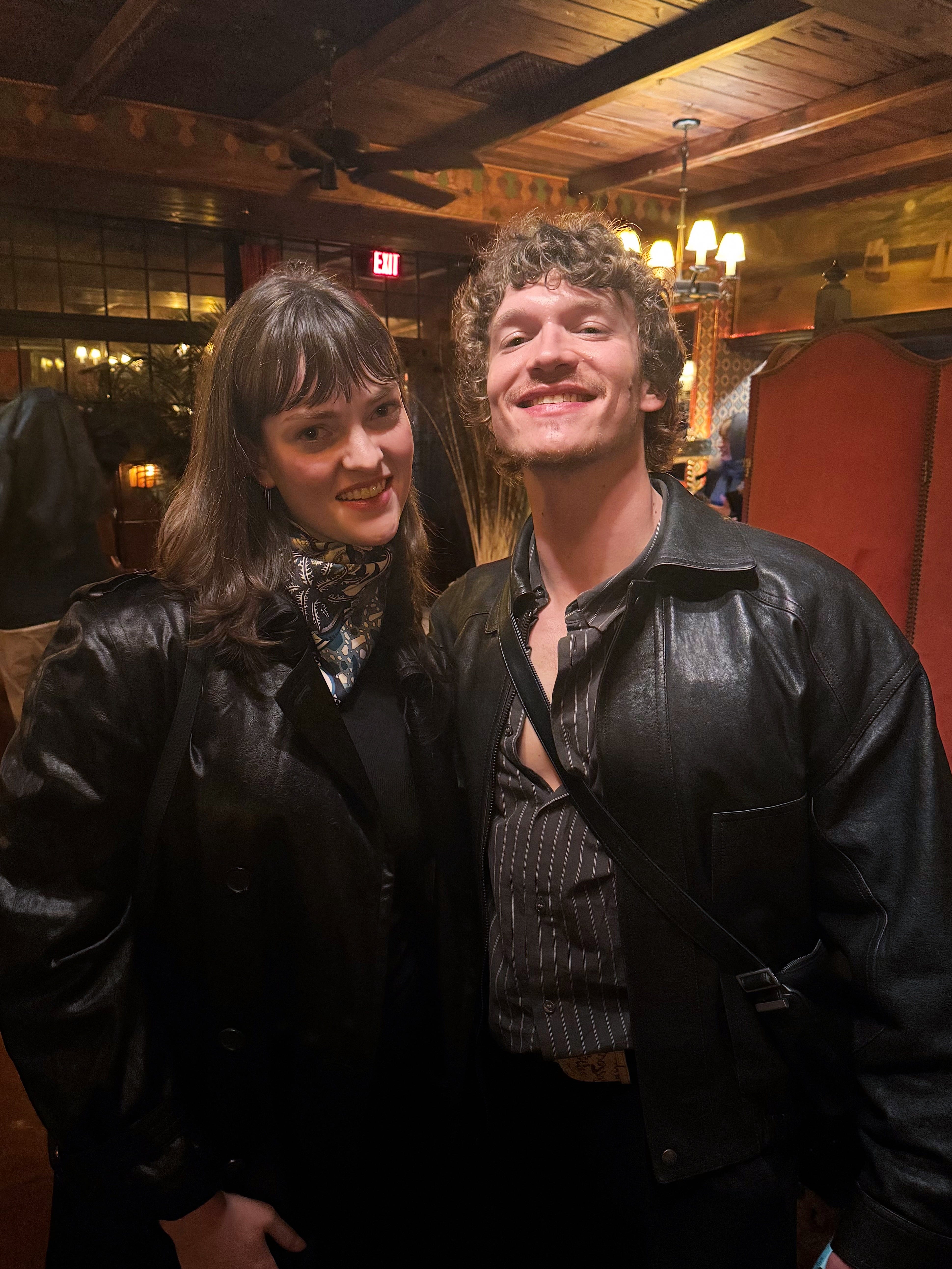
Heated Rivalry is, straight up, gay porn. I do not say this to denigrate the content. I count myself among its fans. The director, Jacob Tierney, is very smart, and Connor Storrie’s acting in particular felt like witnessing a star being born. But I watched with wonder as mainstream culture spoke in tones not even all that hushed about a show that features two full butts on minute 14 of the first episode. (As one might imagine, it only heats up from there.) When I posted a picture with Storrie after running into him at a bar on the Lower East Side, I had former teachers, friends of my mom, parents of high school classmates, and distant family members in my comments, confirming a collective thirst I could not have imagined.
Storrie and co-star Hudson Williams went on to perhaps the most unusual stop in a hot male actor’s press tour these days: recording for the audio erotica app Quinn. The Heated Rivalry boys joined a roster that includes new-age heartthrobs such as Chris Briney (whose teaser trailer alone earned 14.5 million views) as well as Hollywood veterans Sam Heughan of Outlander, BAFTA-award winner Andrew Scott, and Shawn Hatosy, most recently from The Pitt. On a run of back-to-back celebrity cameos that began in July 2025, Quinn’s Instagram account has racked up more than 265 million Instagram views.2
It’s hard to tell exactly who of my mutuals has interacted with Quinn or similar content. Ten years into using the Instagram app, and its settings still confuse me. I regularly forget that my comments on posts are not only public, but are often surfaced by the algorithm in the feeds of people I know. I thought I had toggled off the setting that allows people to see what reels I like, until one of my coworkers told me that I was always liking “such sad things on Instagram.” I was just relieved she hadn’t seen all of my likes on whatever TV series I was obsessed with at the time (recently, it’s been Off Campus, because the world did need another smutty hockey show) or, yes, on Quinn’s videos.
A career as writer, however, and as a memoirist especially, requires a certain amount of self-disclosure. It’s not as easy as setting my account to private and moving on with my life. Almost any book is easier to sell, whether to an agent, publisher, or customer, if you have some sort of following to begin with, and I’ve connected with several writers I admire through platforms such as Instagram and Substack.
In fact, sometimes it seems like extreme exposure is the fastest way to fame. The author of the New Yorker short story “Cat Person” earned a $1.2 million advance for her book and a movie deal with A24 after the story went viral. The author of the Paris Review essay “The Crane Wife” also parlayed their virality into a “memoir in essays” that received widespread critical acclaim.
Personal essays in The Cut or the New York Times’ “Modern Love” column are also often thrown around as launchpads for young writers, outlets that enjoy the thrill of introducing a new voice to their esteemed audience, even if the writer is still rough around the edges—and, importantly, even if the editor abdicates their responsibility to protect the writer from themselves. Recent The Cut essays have included a woman admitting to abandoning a friendship because she found out her friend was using GLP-1s; a woman admitting that, after she had a baby, she neglected her cat to the point of animal abuse; and, most famously, the magazine’s financial advice columnist (also a woman) admitting to falling for a phone scam that led her to put a shoe box with $50,000 in cash into the back of an unmarked car.
The internet rewards exposure, but it’s just as quick to punish it. “Each day on twitter there is one main character. The goal is to never be it,” reads a viral tweet from January 2019, implying that the consequences of virality outweighs its potential values. After filming for Heated Rivalry wrapped, Hudson Williams and Connor Storrie got matching tattoos of the phrase “sex sells,” and they’ve handled their meteoric rise with a remarkable amount of grace. But their internet presence was one of the first places they had to enact guardrails for their new lives. Everyone may have seen their butts, but not everyone needed to see their pre–Heated Rivalry shitposts.
The boundaries of the erotic seem to be in constant flux in our internet era. Thirst traps border genocide border summer swimsuit sales. The Lord giveth, and the Lord taketh away.
This wasn’t strictly true: I hadn’t realized that my other friend’s mom (and another of my bonus parents) had walked down Swift to float in the pool and read. This is the beautiful community that raised me.
As of writing, in late May.
Love youuuuu
Thanks for doxxing my parents